

This week, I went to an “SOS Sewing” class.
—
It was at a little place called The Green Needle, tucked away on the second floor of Damas Supermarket, a Halal store in the Britannia.
I used to live in the Britannia as a teenager, so it was an area I had an emotional attachment to. Nowadays when I visit, the streets feel liminal. Both deeply familiar and entirely foreign, like a memory I can’t quite step back into.
We used to live just a 10-minute walk from the Britannia beach, and maybe 3 blocks from Damas Supermarket, just south of Richmond Road. (I think—I’m directionally challenged.)
While I recall a handful of sketchy incidents, it wasn’t until I hit my twenties that I learned it was and still is a pretty rough neighbourhood.
—
Sure enough, when I arrived at the area for my sewing class, there was a heavy police presence.
It's kind of funny how the sight of those flashing police lights illuminating the night felt so familiar, that I didn’t even make a mental note of that until this moment, as I type this sentence. When I saw the police cars at the side of the street, I just shrugged, took a (loser) lap around the block, and settled for a spot in the nearly-empty lot of a Cineplex just across the road.
I made a mental note that the usual display areas on the exterior walls of the Cineplex were devoid of movie posters. I wondered if that was an indication of a lack of good movies in theatre right now.
I wouldn’t know. I was never able to keep up with pop culture, and somewhere along the way I kinda just gave up.
—
Because I had to trek a block back while carrying a heavy sewing machine, I was 10 minutes late.
I hurried across the street alongside a young boy with caramel skin who wasn’t dressed nearly warm enough. I briefly wondered why this kid was out alone at 6:30pm, crossing the road with no adult supervision. And then I remembered that I had been that kid myself in my childhood. In that one brief encounter with this kid, I was his guardian for that one street crossing. I stared down an impatient driver who almost rolled over us, and made a point to watch the boy scurry safely into the supermarket below my sewing class.
As I ascended the narrow staircase, the familiar sounds of the neighbourhood followed me. The distant laughter, the occasional shouts, and the rhythmic muffled hiss of a bus braking.
The second floor of the building was like a capsule of the community.
I walked past a Christian community centre, a nail salon, a barber, and a Muslim praying centre (I think—I wasn’t paying that much attention), before finally finding the door of The Green Needle.
—
The sewing school was run by Ludmila, a woman with a Slavic accent. Her voice had a grounded, sturdy quality, built on flat, centred vowels that seemed to anchor the room. When she spoke, it sounded rhythmic, almost like singing. Yet punctuated by crisp, distinct consonants, which gave her instructions a sharp sense of precision and a comforting feeling of certainty.
There were two university-aged women there together. I thought they dressed well. Later on, I learned that they were working on their fashion portfolios.
When I was in high school, I had briefly wanted to go to fashion school myself. I’d even convinced my parents to get me a machine for a Grade 11 fashion class. The same machine that I carried into this SOS Sewing class.
As a teenager I was convinced that I’d never get married myself (wrong) nor cared much for weddings (right), but still wanted to design wedding dresses for all my girl friends. This is 100% true. Just ask any one of my girl friends from high school.
Of course, fashion as a career was one of many dreams reserved for the privileged. Certainly not for immigrant kids like me.
My mind briefly fluttered to the boy from the crosswalk. If he ever dreams of fashion as he grows up, I hope he can do more than dream.
—
But a few days ago, I was at the sewing school for a much simpler reason. I was looking for help to get unstuck on a project. Something I intended to complete months ago, ahead of my niece’s birth.
My niece just celebrated her 100 days a week ago.
The project itself only required basic sewing skills, but turns out I didn’t have basic sewing skills. I’d forgotten how to operate my machine, and the thread kept bunching up into a bird’s nest every time I pressed the pedal. After a few unfruitful tries, I decided that I wasn’t getting anywhere at home and looked for expert help.
I had dragged this project on for too long, and I really wanted to finish it.
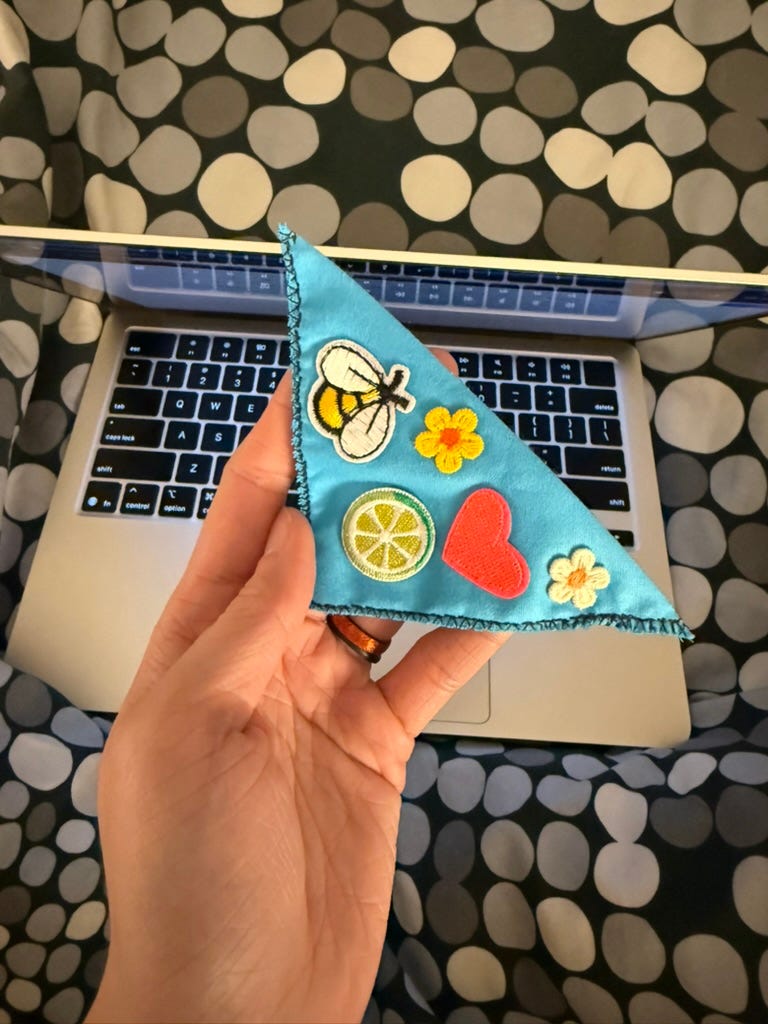
Ludmila demystified my bird’s nest problem, showing me the correct path the thread needed to take on my machine. Then, with stern kindness of a good teacher, she undid all of it and told me to do it myself.
I did okay.
I booked two hours, which I quickly realized I did not need, but I enjoyed every minute.
An hour after I arrived, a couple joined us. They said they run a wedding rental business and brought in a few cloth napkins with frayed seams. They explained that they have hundreds of them that need fixing, and getting them professionally fixed would cost more than purchasing new ones. So they wanted to learn to do it themselves. I thought that was sweet. A practical, shared hustle.
Ludmila took one look at their machine, which they’d bought second-hand just the night before, and told them it was a project in itself and needed servicing. Without skipping a beat, she lent them one of her own school machines to take home, free of charge, so they could get to work.
—
At one point, Ludmila looked around the room. “I like having a bigger class," she declared to all of us, "It feels like Montessori. Everyone’s working on their own thing.”
When she said the word “working,” it had a soft yet solid momentum.Work. A verb with weight and ease at the same time.
Her eyes smiled.
My mom was a Montessori teacher for most of her career in Canada, and also had eyes that smiled.
Words can’t do it justice, but the environment Ludmila had created was something special. The Latin music on the speakers played over a symphony of four sewing machines, each on a different rhythm and frequency. Listening to those mechanical beats weave into the music, I basked in the grounded calm of the room.
As I said my goodbyes and thank yous at the end of the night, I found myself looking for a reason to return. Stepping back out into the cold night, the sewing machine felt a little lighter in my arms than it had two hours ago.
Maybe (big maybe), I will pick up fashion someday after all.
For now, though, I’m going home to finish what I started for my niece.