

I read Siddhartha earlier this year, in February. It was the first Hermann Hesse book I’ve ever read, although I read a few more soon after reading this one.
This book was originally written in German and is composed of beautifully simple language. The story is set in India and follows the spiritual (and physical) journey of self-discovery of Siddhartha during the time of the Gautama Buddha.
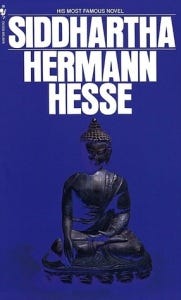
Siddhartha
Title: Siddhartha
Author: Hermann Hesse
Genre: Novel
Written: 1922
Translated: 1951
It had a rather profound impact on me. Even though I am nothing like its main character Siddhartha, I was able to relate to him in more than one way.
The novel is split into two parts, but Siddhartha’s life can be divided into three parts: search, lost, and found.
The first part follows Siddhartha’s journey as the bright and handsome young Brahmin’s son. He was loved by all but was not satisfied. He decides to defy his father, leaves home, and wanders with his friend Govinda to hear Buddha speak. When Govinda decides to follow Buddha, Siddhartha moves on to his journey alone. He argues that each person seeks unique meanings that cannot be taught.
And then, he crosses a river, enters a city, and meets a woman. Kamala, a courtesan, tells Siddhartha that he must become wealthy to win her affections. She says she could teach him the art of love. Siddhartha then indulges in the city life as a businessman. He was very smart, so he did well. At some point, he realizes that the luxurious lifestyle and everything that he was doing was merely a game.
When Siddhartha realizes that he no longer wants to play the game, he leaves the city and returns to the river. This is the river he crossed to enter the city! Symbolic? I think so! He lives out the rest of his days alongside this river with Vasudeva, a simple ferryman, re-encounters Kamala, and eventually achieves enlightenment (I already talked about the plot so much, I don’t want to spoil the ending).
Entrapment in materialism
This book, for me, served as several reminders. The first is a reminder, warning almost, that there are higher meanings to life than material pursuits.
At times he felt, deep in his chest, a dying, quiet voice, which admonished him quietly, lamented quietly; he hardly perceived it. And then, for an hour, he became aware of the strange life he was leading, of him doing lots of things which were only a game, of, though being happy and feeling joy at times, real life still passing him by and not touching him. As a ball-player plays with his balls, he played with his business-deals, with the people around him, watched them, found amusement in them; with his heart, with the source of his being, he was not with them. The source ran somewhere, far away from him, ran and ran invisibly, had nothing to do with his life any more. And at several times he suddenly became scared on account of such thoughts and wished that he would also be gifted with the ability to participate in all of this childlike-naive occupations of the daytime with passion and with his heart, really to live, really to act, really to enjoy and to live instead of just standing by as a spectator.
I think for us, even more so now than when Hesse wrote the book, it’s so easy to fall into the lures of the city, privileges, lust, and the many many things we have and want. Though the story of Siddhartha has a religious context, I think it echoes in all of us. I am guilty of playing a “spectator” sometimes myself.
He saw merchants trading, princes hunting, mourners wailing for their dead, whores offering themselves, physicians trying to help the sick, priests determining the most suitable day for seeding, lovers loving, mothers nursing their children–and all of this was not worthy of one look from his eye, it all lied, it all stank, it all stank of lies, it all pretended to be meaningful and joyful and beautiful, and it all was just concealed putrefaction. The world tasted bitter. Life was torture.
I don’t want the world to taste bitter and life to be torture for me. I want the world to be the taste of honey and life to be bliss. But it’s hard not to fall for the game… because it is a game! It is fun in the first few rounds, at least. Like a gamble — now imagine if you’re very good at it…!
Most of us, unfortunately, can never leave the materialistic world behind us like how Siddhartha leaves the city and looks for his goals.
For how long had he not heard this voice any more, for how long had he reached no height any more, how even and dull was the manner in which his path had passed through life, for many long years, without a high goal, without thirst, without elevation, content with small lustful pleasures and yet never satisfied!
What this “high goal” and “elevation” means, I don’t know, and of course, I’m not saying, “Become a hippie and live by a river!”
I’m only saying, there are more important things than what we can see, what we can touch, what we can hear. There is more than this to life, and we have to find them ourselves.
Perhaps just like Siddhartha, we must find our own goals in our ways, and this story reminds me of that. I sure hope I won’t forget it over time.
Searching vs. Finding
At the beginning of the novel, young Siddhartha is actively searching, but at the end, he achieves enlightenment when he least expects it.
“When someone is searching,” said Siddhartha, “then it might easily happen that the only thing his eyes still see is that what he searches for, that he is unable to find anything, to let anything enter his mind, because he always thinks of nothing but the object of his search, because he has a goal, because he is obsessed by the goal. Searching means: having a goal. But finding means: being free, being open, having no goal. You, oh venerable one, are perhaps indeed a searcher, because, striving for your goal, there are many things you don’t see, which are directly in front of your eyes.”
This was very eye-opening for me because I never thought about finding something when you’re not searching. It just seems so counter-intuitive, but Siddhartha reasons it out in such a rational and matter-of-fact way, that I was almost dumbfounded. How did I never think of this? The logic seems so intuitive!
But then, what does that mean? Does that mean we shouldn’t strive for a goal? No, I still believe we should have goals, but also be open to experiencing everything else surrounding us.
Once upon a time, when I was hiking up a mountain, I turned around by chance and enjoyed the best views of the entire hike. If we can only see that one mountain we wish to climb in the distance, perhaps we can’t see that we have just walked through the most beautiful part of our journey.
Experience vs. Knowledge
In the novel, experience, not knowledge, is the best way to approach understanding of reality and to achieve enlightenment — the sublime and nirvana! Hesse’s Siddhartha goes through a journey that demonstrates that understanding is attained not through knowledge, but wisdom, which doesn’t come from teachings or self-restraints, but through immersing oneself in the pleasures of the world and coming to the sublime through these earthly experiences.
Knowledge can be conveyed, but not wisdom. It can be found, it can be lived, it is possible to be carried by it, miracles can be performed with it, but it cannot be expressed in words and taught.
The events we encounter are not what can lead us to nirvana, yet they are necessary because every action we take and every event we go through gives us experience, which leads us to nirvana.
Love
Is love a game? I believe love requires both an effort in will and an effort in action. If you only want something and don’t do anything for it, there is no love, it’s only a desire. When love is a game, you don’t love the person, you don’t love anybody, you just enjoy the game… Or perhaps, you don’t even enjoy the game. Perhaps the game is devouring you.
“You are the best lover,” she said thoughtfully, “I ever saw. You’re stronger than others, more supple, more willing. You’ve learned my art well, Siddhartha. At some time, when I’ll be older, I’d want to bear your child. And yet, my dear, you’ve remained a Samana, and yet you do not love me, you love nobody. Isn’t it so?”
“It might very well be so,” Siddhartha said tiredly. “I am like you. You also do not love—how else could you practise love as a craft? Perhaps, people of our kind can’t love. The childlike people can; that’s their secret.”
Who is this Kamala? How does she begin to see love as a game? This was a question that lingered over me for the rest of the novel.
Happiness
I have always said that happiness is my only goal in life. Of course, it is made up of several different factors, but happiness can’t be defined. It is just happiness, a state of being, a human feeling. I will write no more, and end with this quotation.
…that fear he loved and sought to always renew it, always increase it, always get it to a slightly higher level, for in this feeling alone he still felt something like happiness, something like an intoxication, something like an elevated form of life in the midst of his saturated, lukewarm, dull life.