Rescuing a chickadee
How to move on from tiny heartbreaks

On a day off in mid-June, my partner came through our front door with distress in his voice.
There’s a chickadee chirping loudly right outside our door, he told me.
I heard the chirping.
It seems to be injured, he told me.
I heard the hurting.
We went out the door together, and assessed the situation.
The chickadee was sitting on the patch of soil right below our front steps, a foot or two from our dryer vent.
It looked to be young, though I wasn’t sure if it was still considered a fledgling. Or maybe it was an adult bird, but because of its helpless position I was biased to think of it as a youngling.
At first glance, I couldn’t even tell that it was hurt. Because it was so tiny, I had to look very closely to notice the head injury. As I kneeled down and got closer to examine it, it didn’t even make an attempt to take flight. I felt my heart sinking, and my eyes well up, as I came to an understanding of the situation.
With its feathers all fluffed up, it sang loudly for such a tiny creature. It made one call only, repeatedly, every 8 seconds or so.
I’ve always adored wild birds, but I’ve never gotten quite that deep into the rabbit hole of ornithology to understand the meanings of different calls. My uneducated guess was that it was the equivalent to an SOS.
As my partner and I watched over the little screeching bird, we heard another call. Coming from another chickadee nearby. First it chirped at us while perched in the shrubs nearby—the ones we’ve been neglecting to trim for the entire spring and early summer. Then, as it noticed us not being a real threat, it flew to the fledgling’s side.
It was the mama bird, my partner and I deduced. Though we could’ve been wrong, of course. Neither of us were ornithologists.
But let’s assume we were right.
—
The mama bird kept bringing little pieces of seeds and straws, and made short little calls at the injured fledgling.
The fledgling ate some of the food, but continued to whine. And the mama bird continued to make the same short, sweet calls that I can only imagine means “there, there”, as she came by again and again.
—
My partner and I discussed our options.
There were only two options, really. In this situation; but honestly, also in life.
Do nothing. And accept the outcome.
Do something. And accept the outcome.
I proposed taking it to a wild bird rescue.
My partner wondered if any rescue would care enough about a mere common chickadee; it’s not like we were rescuing a golden eagle.
While I had similar doubts, I decided that we had to try. So I quickly looked for rescues around us. It turns out that there was only one wild bird rescue organization in our area. I scanned their website as fast as humanly possible for (1) their opening hours, and (2) the types of birds they rescue.
At first, I was discouraged to see the mentions of the more “interesting” wild birds on their website. But their website listed the birds they couldn’t take—Mallard Ducks, Swans, Cormorants, Geese, all due to avian influenza. Chickadees weren’t on it. So I picked up the phone.
After a few questions, they told me, yeah, bring the chickadee in.
—
We felt bad about stealing it from its mama, but ultimately decided that it would have a better chance at survival under the care of (bird) medical professionals.
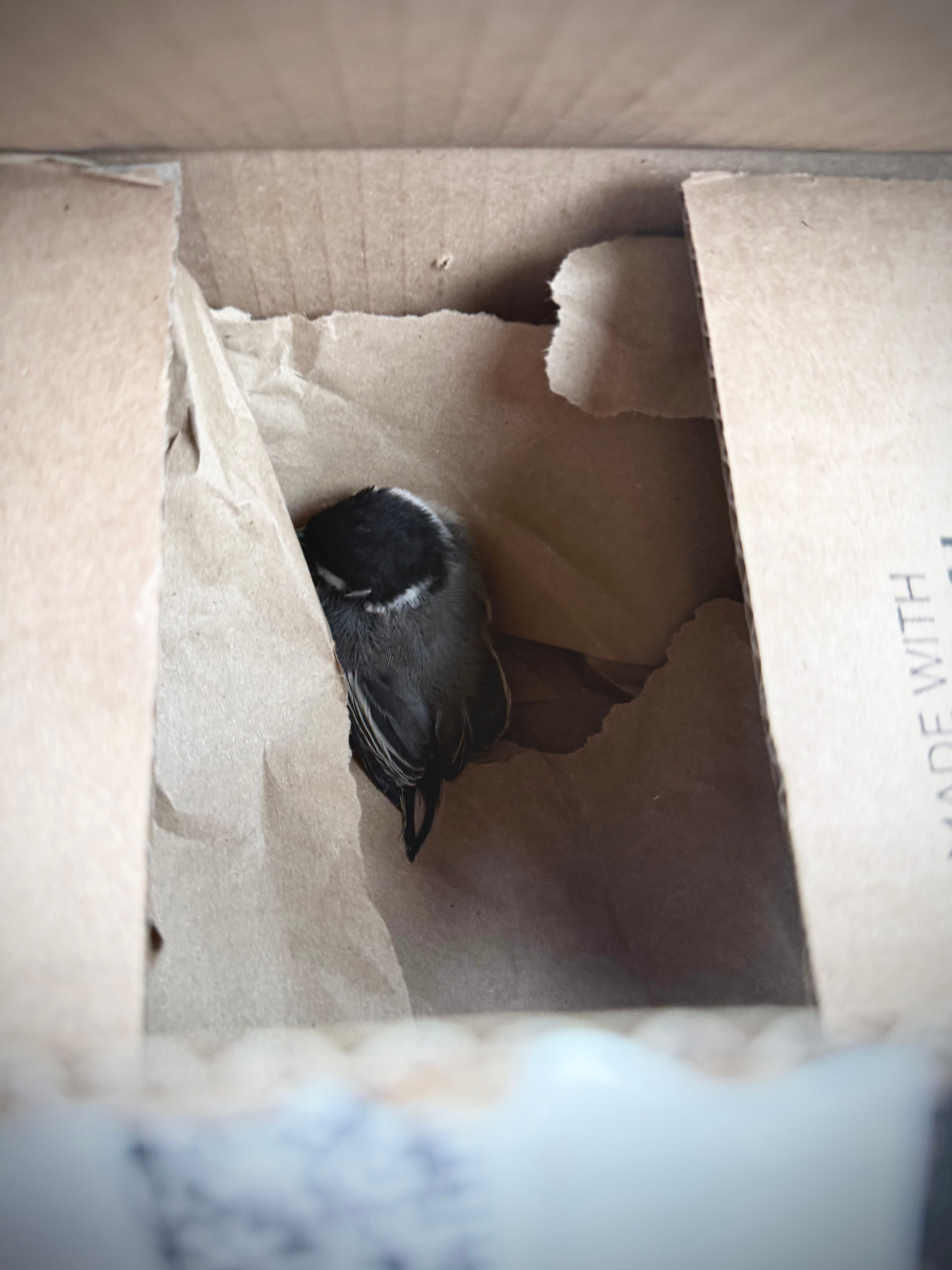
My partner picked up the chickadee and carefully placed it in a cardboard box with some torn-up paper. It didn’t resist at all, and stopped calling loudly almost as soon as it was in the safety of the box.
The 15-minute drive felt long, as I held the box in my lap. It felt like we were on a mission. And I suppose we were.
I peeked into the box every few moments, as if I would find it empty all of a sudden if I didn’t check on the bird. It was so light, as if I wasn’t holding anything at all. Nothing but a tiny little life.
When we got to the rescue, we received a little piece of paper with a reference code, in exchange for the injured bird. We could ask for an update in a few days using the reference code by email, the volunteer told us.
Knowing that gave us some relief, and we continued on with our day.
—
Over the next week, the chickadee was on my mind whenever I had a moment to myself.
In my fantasy, it made a full recovery and was released into the wild. I wondered if it would’ve been able to find its mama. I held my tiny hopes and dreams for the tiny creature delicately in the back of my mind.
After I asked for an update through email, it took the volunteers at the wild bird rescue two weeks to respond. We continued with our work, travels, entertainment, lives. I had started to forget about my tiny hopes and dreams.
I read the email just a few minutes before going into a meeting I had to be “on” for. And as soon as I opened it and saw the length of the email, I knew it was not news I’d like.
Unfortunately, despite their best efforts, the chickadee passed away naturally overnight, they told me. The bird had suffered a critical head injury with a lot of swelling and signs of a serious concussion. There were also wounds to its right wing. The visible signs of injury are often just a small indication of the severity of the internal issues.
They said they were sorry that they didn’t have better news for us. They thanked us for bringing it into their care. They said it allowed them the opportunity to do everything they could to help it recover.
But I stopped reading.
I had a meeting to go into.
My tiny heartbreak was an inconvenience, and I had to put it aside.
I went through the motions of running the meeting. I don’t remember what anyone said, and was grateful for Granola.
—
How do you get over tiny heartbreaks, and continue to try to do something the next time?
The thing is, I don’t think I get over my heartbreaks. I just learn to coexist with them.
We choose our tiny heartbreaks when we choose to care.
We choose to do something instead of nothing.
Even when we know it may not lead to the outcome we hope and dream for. Even when we know it likely leads to another heartbreak.
And sometimes it can be discouraging to choose to care. So sometimes I don’t. And I live with the outcome of doing nothing.
And sometimes I don’t have the capacity to care. Or there might be another something that I have to choose over what’s at hand. So sometimes I don’t. And I live with the outcome of my prioritizations.
But if I’m able to do something instead of nothing, I think it’s better to have tried than to preserve my heart from breaking.
Heartbreaks are wounds of love.
—
Rest easy, little one.